
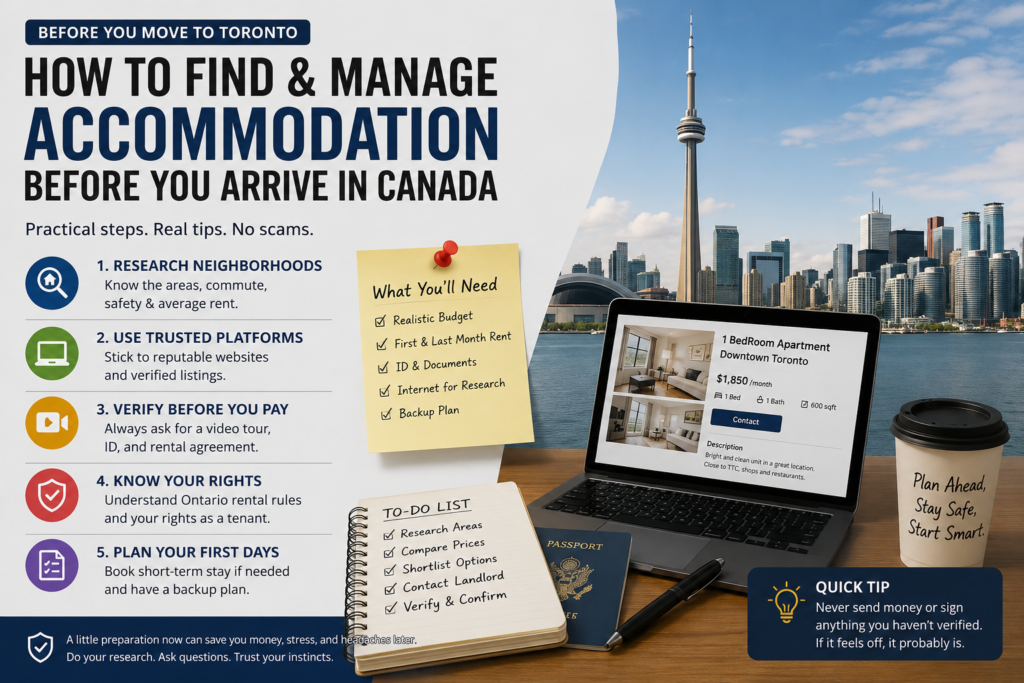
How to Find Accommodation in Canada Before You Arrive — Without Getting Scammed
Written in 2026, based on personal experience in the GTA. Laws and rental rules can change — always verify current rules on the official Government of Ontario website and the Landlord and Tenant Board (LTB) before signing anything.
If you are reading this from outside Canada, scrolling through Facebook groups and rental listings, trying to figure out where you are going to sleep on your first night here — I have been exactly where you are.
This article is the guide I wish someone had handed me before I landed. I am going to walk you through what actually matters: how to find a safe first place, who to trust, what to watch out for, the deposit rules in Ontario, and which areas to consider. No sugar coating. No copying from government websites.
Let’s get into it.
Quick note before we begin: whether you’re moving to Ontario, British Columbia, Alberta, Quebec, Manitoba, or anywhere else in Canada — this article is for you. The big picture is the same everywhere: how scams work, why you should never commit long-term from abroad, who to trust, how to avoid losing money, and what mindset to land with. Those principles are universal.
The only parts that are Ontario-specific are the geography section, the deposit law (Residential Tenancies Act, 2006), and the neighbourhood recommendations — because that’s where I personally moved and where I have direct, lived experience. I’ll be covering other provinces in detail in future articles.
First, Understand the Geography
A lot of newcomers get confused by Canadian geography before they arrive — so let me clear it up in 30 seconds.
Ontario is the province. It’s huge.
The GTA (Greater Toronto Area) is a region inside Ontario that includes the City of Toronto and several surrounding cities like Mississauga, Vaughan, and Markham.
The City of Toronto is one big city. On January 1, 1998, six former municipalities — Old Toronto, Scarborough, North York, East York, Etobicoke, and York — were officially merged into a single new City of Toronto. So today, when someone says they live in Scarborough or North York, they technically live inside the City of Toronto, just in a specific district of it.
In everyday conversation, people still talk about Scarborough and North York like they are separate cities (because culturally, they kind of feel that way). But legally, they are all parts of one big city.
This matters because when you start your search, you’ll see listings tagged “Toronto,” “Scarborough,” “North York” — and they’re all the same city, just different neighbourhoods within it.
Source: City of Toronto Archives (toronto.ca)
Rule #1: Try to Settle Close to the Subway
This is the single most useful piece of advice I can give you.
As a newcomer in the GTA, you almost certainly will not own a car for your first year — maybe longer. That means you’ll be relying on public transit for everything: groceries, your job, college, the doctor, meeting friends.
The GTA’s transit system is operated mainly by the Toronto Transit Commission (TTC), which is the third-largest transit system in North America. It runs subways, streetcars, and buses — so you are well-covered no matter where you live within the city.
The TTC has several subway and light-rail lines, but for most newcomers, the two that matter most are:
- Line 1 (Yonge-University) — runs north-south through the city
- Line 2 (Bloor-Danforth) — runs east-west across the city
Try to find a place as close to a subway station as possible — walking distance is a 10/10 location. The convenience of stepping out of your home and onto the subway, especially in winter, is something you only appreciate once you’ve lived it. That said, getting a walking-distance place near a subway is competitive and not always easy or affordable. If you can’t manage it, don’t worry — TTC buses run regularly, usually every 12 to 15 minutes depending on traffic, and connect almost every part of the city to a subway line. You’ll still get where you need to go.
You can view the official TTC Subway, Light Rail and Streetcar Map on the TTC’s official website. Print it, screenshot it, study it before you arrive. Map source: Toronto Transit Commission, 2026.
Rule #2: Never Make a Long-Term Commitment From Abroad
This is one of the most common mistakes newcomers make — and one of the most expensive.
When you arrange your first accommodation from outside Canada, do not agree to a lease longer than one to three months. Six-month or twelve-month commitments made from abroad are a recipe for regret.
Here’s why:
You don’t know the market. As a newcomer, the first places you see are almost always overpriced. People who’ve lived in Canada for years know what rent should actually be in each neighbourhood. You don’t. Without that knowledge, you can end up paying significantly more than the going rate — and you’re locked in.
You haven’t seen the place with your own eyes. Photos lie. Descriptions lie. The roommates, the noise, the smell, the neighbourhood — none of these can be judged from another country. Many newcomers commit to a place, arrive, and find it’s nothing like what they were promised.
You need flexibility. Your first month or two in Canada is when you’re learning everything. Where do you actually want to live? What’s the commute like to your school or job? Who do you want to live with? You can’t make those decisions before you arrive.
So when arranging from abroad, ask for a short-term arrangement only. If the person on the other end refuses and demands a long lease before you’ve even seen the place — that’s a red flag. Walk away.
Rule #3: The Safest Way to Arrange Your First Accommodation
I’m going to be blunt here. If you’re reading this from Bangladesh, India, Pakistan, the Philippines, Nigeria — anywhere — and you’re about to land in Canada in a few weeks, please listen carefully.
The safest way to arrange your first accommodation is through someone you personally know who already lives in Canada.
Not a stranger on Facebook. Not someone on Kijiji. Not an agent you found through a Google search. A friend. A relative. Someone you actually trust.
Ask them to:
- Look for a short-term place for you (1–3 months only)
- Personally visit the unit and the building on your behalf before you send any money
- Confirm the place is real — not a scam listing
- Look in areas with decent transit access
This last point about visiting the place is critical. Since you can’t see the place yourself, the next best thing is having someone you trust see it for you. A photo of the actual front door, the actual building, the actual landlord standing in front of the unit — these are the proofs that protect you.
If you don’t have anyone in Canada you can trust — wait. Stay in a short-term Airbnb or a hostel for your first week or two, then find a place once you’ve arrived and can see it with your own eyes. The cost of a short-term stay — even for a week or two — is far cheaper than losing thousands to a scam.
Rule #4: Understand Ontario’s Deposit Rule
Here’s a deposit rule every newcomer in Ontario should understand — it can save you a full month of rent if you know how it works.
Under Ontario’s Residential Tenancies Act, 2006, the rule is simple:
A landlord in Ontario is legally allowed to collect a last month’s rent deposit — equal to one month’s rent. That’s the main deposit you should know about.
The first month’s rent is not a deposit — it’s just rent you pay because you’re about to live there. That’s normal.
Important: Laws change. Always check the latest rules on the Government of Ontario’s official website and the Landlord and Tenant Board (LTB) before signing any lease or relying on these details.
How the “Last Month Rent” Deposit Actually Works
This is the part most newcomers don’t understand — and it ends up costing them.
The “last month’s rent” deposit is not extra money. It’s a credit toward your final month in the unit.
When you eventually decide to leave (whether after one year, three years, or ten), the last month’s rent you paid upfront automatically covers your final month of rent. You do not pay rent in your last month. You give proper written notice (typically 60 days in advance, in writing) and use up the deposit.
This is also useful when arranging from abroad. You can structure it this way: send your friend in Canada only the last month’s rent deposit to secure the place. Then, when you arrive, you hand over the first month’s rent yourself, in person, after you’ve seen the unit.
This way you’re not wiring all your savings overseas before you’ve even arrived — and your deposit is sitting safely, waiting to cover your final month whenever you eventually leave.
Rule #5: Never Sign a Document Without Reading It
This should be obvious, but I’ll say it anyway — because excitement and exhaustion are real, and people make this mistake constantly.
Do not sign anything until you’ve read every word.
This includes:
- Paper lease agreements
- Digital lease agreements (DocuSign, PDF, email)
- WhatsApp messages where someone asks you to “confirm” you agree to terms
- Anything that commits you to dates, amounts, or rules
If the document is in English and your English isn’t strong, take your time. Use Google Translate. Ask a trusted friend to read it with you. Never sign in a rush. A landlord pressuring you to sign immediately is another red flag.
Once you sign, you are legally bound. Read first. Sign later.
Where Should You Look in the GTA?
Now let’s talk about specific areas. The GTA is huge, and not all areas are equal for newcomers.
For your first place, I’d suggest looking into these three districts within the City of Toronto:
Scarborough — Affordable rents compared to other parts of the city, large South Asian and immigrant communities (so the food, groceries, and culture feel familiar), and reasonable transit access. A lot of newcomers from Bangladesh, India, Pakistan, Sri Lanka, and the Philippines settle here for exactly these reasons.
North York — Well-served by Line 1 going north along Yonge Street. Slightly higher rent than Scarborough but with strong transit connections and diverse newcomer communities, schools, and grocery options.
East York — A quieter, more residential area with decent Line 2 access. Smaller than the other two but a solid middle-ground option.
These three are the most common starting points for newcomers, and for good reasons: affordability (relative to other parts of the GTA), community presence, and transit access.
I’ll be covering other GTA cities and provinces in future articles. I’m not giving exact rent amounts here because prices vary too much by neighbourhood and change quickly — what was true six months ago may not be true today. Always verify current local prices when you start your search.
Quick Summary — Save This
Here’s everything in this article, condensed into a checklist:
- Understand the geography: Ontario is the province, the GTA is the region, the City of Toronto includes Scarborough/North York/East York as districts
- Try to settle within walking distance of a TTC subway station — walking distance is a 10/10 location
- If you can’t manage walking distance, TTC buses run every 12–15 minutes and connect everywhere
- Never commit to more than 1–3 months from abroad
- Only arrange first accommodation through someone you personally trust who lives in Canada
- Ask that person to visit the place in person before any money changes hands
- If you have no contacts in Canada, book a short-term Airbnb or hostel first, then find a place after arriving
- Ontario law (Residential Tenancies Act, 2006) allows a last month’s rent deposit — verify the latest rules on the official Ontario government / LTB website before signing
- Your last month’s rent deposit covers your final month — you don’t pay rent that last month
- Never sign any document (paper or digital) without reading every word
- For your first place: Scarborough, North York, or East York are common newcomer starting points
- Print or screenshot the TTC subway map before you arrive
Final Word
Finding your first home in a country you’ve never lived in is one of the most stressful parts of moving abroad. I went through it myself, made mistakes, and learned the hard way.
If this article saves even one person from signing a lease they regret, or from sending money to a scam landlord, then writing it was worth it.
Take it slow. Trust the right people. Don’t commit before you arrive. Know your rights. Verify the current rules on official sources.
The rest will come.
Have a question about finding accommodation in the GTA? Share your situation in the comments — I read every one. And if you’re about to make this move, share this article with someone who needs to hear it.
Coming soon: A full guide to navigating the Toronto Transit Commission (TTC) — buses, subways, streetcars, and how to get around as a newcomer.